Showing posts with label MANAGEMENT TERMS. Show all posts

Tuesday, May 7, 2013

Argyris


Studied the needs of people and the needs of organisation. He felt that classical models of organisation promoted 'immaturity' (see below). He felt that it was important to understand the needs of people and integrate them with needs of organisation. Only in this way, he said, can employees become co-operative rather than defensive or aggressive
 
Characteristics of Employee
Immaturity                                                                      Maturity
Passivity ---------------------------------------------------Activity
Dependence--------------------------------------------------Relative independence
Behave in a few ways----------------------------------------Behave in many ways
Erratic, shallow interests----------------------------------Deeper interests
Short time perspective-------------------------------------Long time perspective
Subordinate position-------------------------------------------Equal or superior position
Lack of awareness of self---------------------------------------Awareness and self control

Advantages
  • Argyris is moving here towards a 'contingency approach' i.e. remedy depends on diagnosing problems first
  • He presents a spectrum rather than bipolar patterns of employees behaviour could be expected from immaturity to maturity. Certain behaviours of employees may be preferred
Disadvantages
  • Still too centred around 'self -actualising man'. Viewed not to be applicable to production lines with manual workers, workers in sterile supplies, people manning phone helplines etc whose needs are perceived to be typically lower in Maslow's hierarchy of needs

RENSIS LIKERT


Described 'new patterns of management' based on the behaviours of managers

Four main patterns:
 
1. Exploitative - authoritative where power and direction come from the top downwards', where threats and punishment are employed, where communication is poor and teamwork non-existent. Productivity is typically mediocre 'Rational economic man'
2. Benevolent - authoritative is similar to the above but allows some upward opportunities for consultation and some delegation. Rewards may be available as well as threats. Productivity is typically fair to good but at cost of considerable absenteeism and turnoverWeaker version of 'rational - economic man'
3. Consultative where goals are set or orders issued after discussion with subordinates, where communication is upwards and downwards and where teamwork is encouraged, at least partially. Some involvement of employees as a motivator'social man'
4. Participative - group is reckoned by many to be the ideal system. Under this system, the keynote is participation, leading to commitment to the organisation's goals in a fully co-operative way. Communication is both upwards, downwards and lateral. Motivation is obtained by a variety of means. Productivity is excellent and absenteeism and turnover are lowSelf - actualising man
(see also McGregor: theory Y)

Another useful way of looking at this is that (1) is a highly task-orientated management style, whereas (4) is a highly people-orientated management style.

Advantages

Essentially Likert's work gives more alternatives in the spectrum between Theory X and Theory Y of McGregor
Disadvantage
  • criticised for being based more on theory than empirical practice. Therefore not widely accepted by practising managers.

Herzberg's motivation hygiene theory


200 engineers and accountants were asked to recall the times/occasions when they experienced satisfactory and unsatisfactory feeling about their jobs. Later this also involved manual and clerical staff similar results claimed:

Herzberg showed two categories of findings:

Motivators - factors giving rise to satisfaction
Hygiene factors - factors giving rise to dissatisfaction

 
Important MotivatorsImportant Hygienes
AchievementCompany policy and recognition
RecognitionSupervision - the technical aspects
Work itselfSalary
ResponsibilityInterpersonal relations - supervision
AdvancementWorking conditions

Other features include:
 
MotivatorsHygiene Factors
related to content of work related to context/environment of work
promote satisfaction   only prevent dissatisfaction
only neo-human school attempts to address theseTaylor (salary) + Mayo (interpersonal relations) look at these

Advantages
  • Herzberg's work led to a practical way to improve motivation, which had, up to that point, been dominated by Taylorism (salary, wages). In particular ' job enrichment' programs mushroomed. The aim of these was to design work and work structures to contain the optimum number of motivators.
  • This approach counters the years of Taylorism, which sought to break down work into its simplest components and to remove responsibility from individuals for planning and control.
Disadvantages
  • There remain doubts about Herzberg's factors applicability to non-professional groups, despite the fact that some of his later studies involved the clerical and manual groups. The numbers were in these categories though were small and many researchers still argue about the results in these groups.
  • Social scientists argue about the validity of his definition of 'job satisfaction'


McGregor (Theory X and Theory Y)

Managers were perceived by McGregor, whose theories are still often quoted, to make two noticeably different sets of assumptions about their employees.
 
Theory X (essentially 'scientific' mgt)Theory Y
LazyLike working
Avoid responsibilityAccept/seek responsibility
Therefore need control/coercionNeed space to develop imagination/ingenuity
Schein type: 'rational economic man'Schein type: 'self-actualising man'

Advantages
  • Identifies two main types of individual for managers to consider and how to motivate.
Disadvantages
Only presents two extremes of managerial behaviour.

MASLOW


Maslow is often-quoted still today, having developed a seminal theory of the needs of human beings. Herzberg's and McGregor's neo-human relations theories both focus on motivation and leadership, but their theories are, as we shall see, very different.

In this group we find a particular focus on human motivation including:
  • satisfaction
  • incentive
  • intrinsic
  1. This psychologist, from his studies, proposed a hierarchy of human needs building from basic needs at the base to higher needs at the top.
  1. Maslow made assumptions that people need to satisfy each level of need, before elevating their needs to the next higher level e.g. a hungry person's need is dominated by a need to eat (i.e survival), but not to be loved, until he/she is no longer hungry.
     
  2. Today the focus in most Western societies is on the elements towards the top of Maslow's hierarchy - in which work environments and 'jobs' (including 'having a job' and the satisfaction or otherwise such jobs provide - have become typical features. Notably the attainment of self-esteem and, at the very top of the hierarchy, what Maslow calls 'self-actualisation' - fundamentally the synthesis of 'worth', 'contribution' and perceived 'value' of the individual in society.
Advantages
  • Managers can/should consider the needs and aspirations of individual subordinates.
Disadvantages
  • The broad assumptions in 2 above have been disproved by exceptions e.g. hungry, ill artist working in a garret.
  • Empirical research over the years has not tended to support this theoretical model.
Regarding monetary reward, sometimes beyond certain level of pays (e.g. consultant) other things become more important than another £1000 a year
e.g. working conditions, boss, environment etc.

Elton Mayo: Hawthorns studies


Where Classical theorists were concerned with structure and mechanics of organisations, the theorists of human relations were, understandably, concerned with the human factors.

The foci of human relations theory is on motivation, group motivation and leadership.

At the centre of these foci are assumptions about relationship between employer and employee. Best summarised by Schein (1965) or Elton Mayo
  • they were academic, social scientists
  • their emphasis was on human behaviour within organisations
  • they stated that people's needs are decisive factors in achieving an organisation's effectiveness
  • they were descriptive and attempted to be predictive of behaviour in organisations
A 'motive' = a need or driving force within a person.

The process of motivation involves choosing between alternative forms of action in order to achieve some desired end or goal


Alternative forms of action of motivation depend on a manager's assumptions about his/her subordinates:
 Prime MotivatorsTheory
1. Rational- economic manSelf interest and maximisation of gainBasis of Classical, especially, Taylor/Scientific theory
2. Social manSocial need, being part of a groupBasis of Mayo
3. Self actualising manSelf-fulfilment of individualMaslow, Likert, McGregor, Argyris, Herzberg
4. Complex manDepends on individual, group, task'Systems approach'

Elton Mayo : Hawthorne Studies

The ground-breaking Hawthorne studies carried out in the Hawthorne plant of the Western Electric Company (USA) 1927 - 32.

Stage 1 (1924 -27)
Study of the physical surroundings (lighting level) on productivity of workers. Control group and experimental group previously had similar productivity before study began

Control Group = constant lighting level
Experimental Group = varied lighting level

Result
Both groups productivity increased - even when experimental group was working in dim light

Product leader called Mayo and colleagues to explain

Stage 2 (1927 - 29) 'Relay assembly room stage'
Still analysing effect of physical surroundings (rest, pauses, lunch break duration, length of working week) on output

Result
Output increased even when worsening conditions
Hypothesis was now that it was the attitudes of subjects at work and not the physical conditions. This gave rise to the 'Hawthorne Effect' - employees were responding not so much to changes in the environment as to the fact they were the centre of attention - a special group.

Stage 3 (1928 - 30)
A Total of 20,000 interviews were collected with the workers on employee attitudes to working conditions, their supervision and their jobs.

Stage 4 (1932) 'Bank winning observation room'
This time the new subjects (14 men) put in separate room for six months

Result
Productivity restricted due to pressure from peers to adopt a slower rate to circumvent company wages incentive scheme to generally adopt own group rules and behaviour

Advantages
  • first real attempt to undertake genuine social research in industrial setting
  • individuals cannot be treated in isolation, but function with group members
  • that individual motivation did not primarily lie in monetary or physical condition, but in need and status in a group
  • the strength of informal (as opposed to formal) groups demonstrated a behaviour of workers (formal supervisors were powerless in Stage 4)
  • it highlighted need for supervisors to be sensitive and cater for social needs of workers within the group
Disadvantages
  • from 1930s -1950s some doubt was cast on the increased applicability of these theories to every day working life

Max Weber (1864 - 1924), Germany


Bureaucracy in this context is the organisational form of certain dominant characteristics such as a hierarchy of authority and a system of rules.

Bureaucracy in a sense of red tape or officialdom should not be used as these meanings are value-ridden and only emphasize very negative aspects of the original Max Weber model.

Through analyses of organisations Weber identified three basic types of legitimate authority: Traditional, Charismatic, Rational-Legal.
Authority has to be distinguished from power in this discussion. Power is a unilateral thing - it enables a person to force another to behave in a certain way, whether by means of strength or by rewards. Authority, on the other hand, implies acceptance of the rules by those over whom it is to be exercised within limits agreeable to the subordinates that Weber refers to in discussing legitimate authority.

Weber presented three types of legitimate authority:
Traditional authority: where acceptance of those in authority arose from tradition and custom.
Charismatic authority: where acceptance arises from loyalty to, and confidence in, the personal qualities of the ruler.
Rational-legal authority: where acceptance arises out of the office, or position, of the person in authority as bounded by the rules and procedures of the organization.

It is the rational-legal authority form that exists in most organisations today and this is the form to which Weber ascribed the term 'bureaucracy'.

The main features of bureaucracy according to Weber were:
  • a continuous organisation or functions bounded by rules
  • that individuals functioned within the limits of the specialisation of the work, the degree of authority allocated and the rules governing the exercise of authority
  • a hierarchical structure of offices
  • appointment to offices made on the grounds of technical competence only
  • the separation of officials from the ownership of the organisation
  • the authority was vested in the official positions and not in the personalities that held these posts. Rules, decisions and actions were formulated and recorded in writing.
It is not coincidence that Weber's writings were at a time of the major industrial revolutions and the growth of large complex organisations out of the cottage industries and/or entrepreneurial businesses.

The efficiency of this rational and logistical organisation shares a considerable amount of common ground with the thinking of Fayol. In particular, features such as scalar chain, specialisation, authority and the definition of jobs which were so essential to successful management as described by Fayol, are typical of bureaucracy. There is also little doubt that Weber's ideas concerning specific spheres of competence and employment based on technical competence would have considerable appeal for Taylor's scientific managers.

Advantages
  • Appointment, promotion and authority were dependent on technical competence and reinforced by written rules and procedures of promoting those most able to manage rather than those favoured to manage. We take a lot of this for granted in the UK today. Anything else is regarded as nepotism and corruption.
  • The adoption of bureaucratic type of management systems allow organisations to grow into large complex organised systems that are focused towards formalised explicit goals.
  • It cannot be stated strongly enough that the Weber theory has the advantage of being used as a 'gold standard' on which to compare and develop other modern theories.
Disadvantages
Subsequent analysis by other researchers have identified many disadvantages:
  • Tendency for organisations to become procedure dominated rather than goal dominated.
  • Tendency for heavily formalised organisational roles to suppress initiative and flexibility of the job holders.
  • Rigid behaviour by senior managers can lead to standardised services that do not meet the needs of the client.
  • Rigid procedures and rules are demotivating for the subordinates that work in the organizations.
  • Exercise of control based on knowledge as advocated by Weber has led to the growth of 'experts' whose opinions and attitudes may frequently clash with those of the more generalised managers and supervisors.

Henri Fayol (1841 - 1925), France


1.Division of workReduces the span of attention or effort for any one person or group. Develops practice and familiarity
2. AuthorityThe right to give an order. Should not be considered without reference to responsibility
3. DisciplineOutward marks of respect in accordance with formal or informal agreements between firm and its employees
4. Unity of commandOne man superior
5. Unity of directionOne head and one plan for a group of activities with the same objective
6. Subordination of individual interests to the general interestThe interests of one individual or one group should not prevail over the general good. This is a difficult area of management
7. RemunerationPay should be fair to both the employee and the firm
8. CentralisationIs always present to a greater or less extent, depending on the size of the company and quality of its managers
9. Scalar chainThe line of authority from top to bottom of the organisation
10. OrderA place for everything and everything in its place; the right man in the right place
11. EquityA combination of kindliness and justice towards the employees
12. Stability of tenure of personnelEmployees need to be given time to settle into their jobs, even though this may be a lengthy period in the case of the managers
13. InitiativeWithin the limits of authority and discipline, all levels of staff should be encouraged to show initiative
14. Esprit de corpsHarmony is a great strength to an organisation; teamwork should be encouraged

Advantages
  • Fayol was the first person to actually give a definition of management which is generally familiar today namely 'forecast and plan, to organise, to command, to co-ordinate and to control'.
  • Fayol also gave much of the basic terminology and concepts, which would be elaborated upon by future researchers, such as division of labour, scalar chain, unity of command and centralization.
Disadvantages
  • Fayol was describing the structure of formal organizations.
  • Absence of attention to issues such as individual versus general interest, remuneration and equity suggest that Fayol saw the employer as paternalistic and by definition working in the employee's interest.
  • Fayol does mention the issues relating to the sensitivity of a patients needs, such as initiative and 'esprit de corps', he saw them as issues in the context of rational organisational structure and not in terms of adapting structures and changing people's behaviour to achieve the best fit between the organisation and its customers.
  • Many of these principles have been absorbed into modern day organisations, but they were not designed to cope with conditions of rapid change and issues of employee participation in the decision making process of organisations, such as are current today in the early 21st century.

F W Taylor - (1856 - 1915), USA- The Scientific Management School


Taylorism involved breaking down the components of manual tasks in manufacturing environments, timing each movement ('time and motion' studies) so that there could be a proven best way to perform each task. Thus employees could be trained to be 'first class' within their job. This type of management was particularly relevant to performance drives e.g 'Action On' projects.

This was a rigid system where every task became discrete and specialized. It is fair to suggest that this is unlikely to be of value to the NHS with the Modernisation agenda suggesting that we should have a flexible workforce.

Key points about Taylor, who is credited with what we now call 'Taylorism':
  • he was in the scientific management school
  • his emphases were on efficiency and productivity
  • but he ignored many of the human aspects of employment
For the managers, scientific management required them to:
  • develop a science for each operation to replace opinion and rule of thumb
  • determine accurately from the science the correct time and methods for each job (time and motion studies)
  • set up a suitable organisation to take all responsibility from the workers except that of the actual job performance
  • select and train the workers (in the manner described above)
  • accept that management itself be governed by the science deployed for each operation and surrender its arbitrary powers over the workers, i.e. cooperate with them.
For the workers, scientific management required them to:
  • stop worrying about the divisions of the fruits of production between wages and profits.
  • share in the prosperity of the firm by working in the correct way and receiving wage increases.
  • give up their idea of time wasting and co-operate with the management in developing the science
  • accept that management would be responsible for determining what was done and how
  • agree to be trained in new methods where applicable
The benefits (mainly for the management) arising from scientific management can be summarised as follows:
  • its rational approach to the organisational work enables tasks and procedures to be measured with a considerable degree of accuracy
  • measurement of paths and processes provide useful information on which to base improvements in working methods, plant design, etc
  • improving work methods brought enormous increases in productivity
  • it enabled employees to be paid by results and to take advantage of incentive payments
  • it stimulated management into adopting a more positive role in leadership at shop floor level.
  • it contributed to major improvements in physical working conditions for employees
  • it provided the formation for modern work studies
The drawbacks were mainly for the workers:
  • it reduced the worker's role to that of a rigid adherence to methods and procedures over which he/she had no discretion
  • it led to increased fragmentation of work due to its emphasis on divisional labour
  • it generated an economically based approach to the motivation of employees by linking pay to geared outputs
  • it put the planning and control of workplace activities exclusively in the hands of the managers
  • it ruled out any realistic bargaining about wage rates since every job was measured and rated 'scientifically'
Therefore, in summary, while the scientific management technique has been employed to increase productivity and efficiency both in private and public services, it has also had the disadvantages of ignoring many of the human aspects of employment. This led to the creation of boring repetitive jobs with the introduction of systems for tight control and the alienation of shop floor employees from their managers.

Taylorism prevailed in the '30s through to the early '60s - and in many organisations considerably later than this. Peters and Waterman in the 70s/80 and Senge late '80s/early '90s led us towards what we now call 'systems thinking' where the rights and potential wider contributions of employees received considerably greater emphasis.

Friday, April 26, 2013

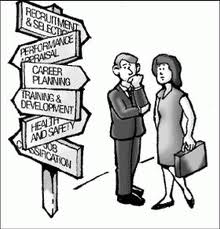
Important terms in Human Resource Management/ Personnel Management


Important terms in Human Resource Management/ Personnel Management

Human Resources
The total knowledge, skills, creative abilities, talents and aptitudes of an organisation’s workforce, as well as the value, attitudes and beliefs of individuals involved 


Human Resource Management (HRM)
HRM refers to a set of programmes, functions and activities designed and carried out in order to maximise both employee as well as organisational effectiveness.
Human Resource Management is a function of guiding human resources into a dynamic organisation that attains its objectives with a high degree of morale and to the satisfaction of those concerned.
HRM is that phase of management which deals with the effective control and use of manpower as distinguished from other sources of power.
The management of human resources is viewed as a system in which participants seeks to attain both individual and group goals.
The objective of HRM is to understand what has happened and is happening and to be prepared for that will happen in the area of working relationships between the managers and the managed.
Manpower/Human Resource Planning
It is the process of determining manpower requirements and the means for meeting those requirements in order to carry out the integrated plan of the organisation.”

Job Analysis
Job analysis is the process of determining, by observation and study, and reporting pertinent information relating to the nature of s specific job.  It is the determination of the tasks which comprise the job and of the skills, knowledge, abilities and responsibilities required of the worker of a successful performance and which differentiate one job from all others
Job Description
It is an organised, factual statement of the duties and responsibilities of a specific job.  In brief it should tell what is to be done, how it is done and why?  It is a standard of function, in that it defines the appropriate and authorised content of a job.
Job Specification
Job specification or man specification or employee specification is a statement of the minimum acceptable human qualities necessary to perform a job properly.  In contrast to the job description it is a standard of personnel and designates the qualities required for acceptable performance.


Job Evaluation
Job evaluation is an attempt to determine and compare demands which the normal performance of a particular job makes on normal workers without taking into account the individual abilities on performance of the workers concerned.”
Absenteeism
Absenteeism means the failure of a worker to report for work when he is scheduled to work.  Labour Turnover
Labour turnover refers to the rate of change in the workforce of an enterprise during a given time period. 
Recruitment
Recruitment is the process of searching for prospective employees and stimulating and encouraging them to apply for jobs in an organisation.
Recruitment Policy
Recruitment policy specifies the objectives of recruitment and provides a framework for the implementation of the recruitment programme.
Selection
Selection involves picking for hire a subset of workers from the total set of workers who have applied for the job.
Interview
Interview is a face-to-face, observational and personal appraisal method of evaluating the applicant where the interviewer who is higher in status is in a dominant role.
Placement
It is a decision to place a selected individual in one job than in another. 
Induction
It is the process of inducting a new employee into the new social setting of his work.
Promotion
A promotion takes place when an employee moves to a position higher than the one formerly occupied.
Dry Promotion
When there is no increase in the employee’s pay as a result of promotion it is called as a dry promotion. 
Demotion  
 It is a downward movement of an employee in the organisational hierarchy with lower pay, status or responsibilities.
Transfer  
A transfer implies a lateral movement of an employee in the hierarchy of positions with the same pay and status. 
Training and Development
The organised procedure by which people learn knowledge and/or skill for a definite purpose is training.
Job Rotation
This type of training involves the movement of the trainee from one job to another. 
Management Development Programme
It is a systematic process of growth and development by which the managers develop their abilities to manage. 
Career
It is a sequence of separate but related work activities that provides continuity, order and meaning in a person’s life.


Motivation
It is defined as any idea, need, emotion or organic stage, that prompts a man to an action.
Job Satisfaction
It refers to the feelings and the emotional aspects of individuals experience towards his jobs,
Performance Appraisal
It is the systematic, periodic and an impartial rating of an employees’ excellence in matters pertaining to his present job and his potential for a better job.
Management By Objectives (MBO)
It is a process whereby the supervisor and subordinate managers of an organisation jointly identify its common goals, define each individual’s major areas of responsibility in terms of unit and assessing the contributions of each of its members.
Trade Unions
It is a voluntary organisation of workers formed to promote and protect their interests by collective action.
Collective Bargaining
It refers to a process by which employers on the one hand and representatives on the other, attempt to arrive at agreements covering the conditions under which employees will contribute and be compensated for their services.
Workers Participation in Management
It is a process by which authority and responsibility of managing industry are shared with workers.
Job Design
It is the process of deciding on the contents of a job in terms of its duties and responsibilities, on the methods to be used in carrying out the job, in terms of techniques, systems and procedures and on the relationships that should exist between the job holder and his superiors, subordinates and colleagues.

Important terms in Marketing Management


Important terms in Marketing Management 

1. Administered Vertical Marketing System: An arrangement that coordinates distribution activities through the market and/or economic power of one channel member or the shared power of two channel members.
 It can also be said that, it is a system in which the channel members, while retaining much of their autonomy, are informally coordinated in their marketing activities by the dominant member of the channel.  Dominance is achieved through the exercise of political or economic power rather than through outright ownership. 


Contractual Channel System / Contractual Vertical Marketing System: A system in which independent channel members at two or more levels have entered into formal agreements to coordinate their marketing efforts in an attempt to take advantage of the economies of scale.  Contractual vertical marketing systems are generally of three types: i. Voluntary chains, ii. Retail cooperatives, and iii. Franchisee operations.

Corporate System / Corporate Vertical Marketing System: A system in which a large corporation controls two or more levels of a marketing channel.  For example, a manufacturer may own the distribution facilities for his product as well as the retail outlets through which it is sold.

2. Advertising: All activities involved in presenting to an audience a nonpersonal, sponsor-identified, paid-for message about a product/service of an organization.
3. Advertising Agency: An independent company that provides specialized advertising services and may also offer more general marketing assistance.
4. Advertising Media: The communication vehicles (such as newspapers, radio, television etc) that carry advertising as well as other information and entertainment.
5. AIDA: A sequence of steps in various forms of promotion, notably personal selling and advertising, consisting of Attention, holding Interest, arousing Desire, and generating buyer Action.
6. Marketing Plan: A written document that presents the master blueprint for a year’s marketing activity for a specified organizational division or major product.
7. Automatic Vending: A form of nonstore retailing where the products are sold through a machine with no personal contact between the buyer and seller.
8. Banner Ad: A boxed-in promotional message often appearing at the top of a web page.
9. Behavioural segmentation: Market segmentation based on consumers’ product-related behaviour, typically the benefits desired from a product and the rate at which the consumer uses the product.
10. Brand: A name and/or mark intended to identify and differentiate the product of one seller or a group of sellers.
11. Brand mark: The part of a brand that appears in the form of a symbol, design, or distinctive colour or types of lettering.
12. Brand Name: The part of a brand that can be vocalized-words, letters, and/or numbers. 
13. Broker: A middleman who brings buyers and sellers together and provides market information to either party and that ordinarily neither physically handles products being distributed nor works on a continuing basis with those sellers or buyers.
14. Business Analysis: It is one of the stages in the new product development process which consists of several steps to expand a surviving idea into a concrete business proposal.
15. Buying Motive: The reason why an individual or an organization buys a specific product or makes purchases from a specific firm.
16. Channel Conflict: A situation in which one channel member perceives another channel member to be acting in a way that prevents the first member from achieving.
17. Comparative Advertising: A form of selective-demand advertising in which an advertiser either directly (by naming a rival brand) or indirectly (through inference) points out the differences among competing brands.
18. Consumer buying-decision process: The series of logical stages, which differ for consumers and organizations, that a prospective purchaser goes through when faced with a buying problem.
19. Cost-plus pricing: A major method of price determination in which the price of a unit of a product is set at a level equal to the unit’s total cost plus a desired profit on the unit.
20. Countertrade: An arrangement under which domestically made products are traded for imported goods.
21. Culture: A complex of symbols and artifacts created by a society and handed down from generation to generation as determinants and regulators for human behaviour.

22. Customer Relationship Management (CRM): An ongoing interaction between a buyer and a seller in which the seller continuously improves its understanding of the buyer’s needs, and the buyer becomes increasingly loyal to the seller because his needs are being so well satisfied.
23. Decline stage: The fourth, part of a product life cycle during which the sales of a product drops.
24. Delphi Method: A forecasting technique, applicable to sales forecasting, in which a group of experts individually and anonymously assess future sales, after which each member has the chance to offer a revised assessment as the group moves toward a consensus.
25. Demand Forecasting: The process of estimating sales of a product during some future period.
26. Demographic segmentation: Subdividing markets into groups based on population factors such as size, age, and growth.
27. Department store: A large-scale retail institution that has a very broad and deep product assortment, tries not to compete on the basis of price, and offers a wide array of customer services.
28. Diffusion: A process by which an innovation spreads throughout a social system over time.
29. Direct distribution: A channel consisting only of producer and final customer, with no middlemen providing assistance.
30. Direct marketing: A form of nonstore retailing that uses advertising to contact consumers who, in turn, purchase products without visiting a retail store.
31. Direct selling: A form of nonstore retailing in which personal contact between a sales person and a consumer occurs away from a retail store.  Sometimes called in-home selling.
32. Discount store: A large-scale retail institution that has a broad and shallow product assortment, low prices, and few customer services.
33. Distribution channel: The set of people and firms involved in the transfer of title to a product as the product moves from producer to ultimate consumer or business user.
34. Drop shipper: A merchant wholesaler that does not physically handle the product being distributed, but instead sells merchandise for delivery directly from the producer to the customer.  Same as desk jobber.
35. Early adopters: A group of consumers that includes opinion leaders, is respected, has much influence on its peers, and is the second group (following the innovators) to adopt an innovation.
36. Economic environment: A set of factors, including the business cycle, inflation, and interest rates, that affect the marketing activities of an organization.
37. 80-20 principle: A situation in which a large proportion of the total orders, customers, territories, or products account for only a small share of the company’s sales or profit, and vice-versa.
38. Electronic Commerce: The buying and selling of goods and services through the use of electronic networks.
39. Family branding: A strategy of using the company name for branding purposes.
40. Family-life-cycle stage: The series of life stages that a family goes through, starting with young single people, progressing through married stages with young and then older children and ending with older married and single people.
41. First – mover advantage: Strategy of entering a market during the introductory stage of a product in order to build a dominant position; also called pioneer advantage.
42. Focus group: A preliminarly data gathering method involving an interactive interview of 4 to 10 people.
43. Franchising: A type of contracatual vertical marketing system that involves a continuing relationship in which franchiser (the parent company) provides the right to use a trademark plus various management assistance in return for payments from a franchisee (the owner of the individual business unit).
44. Gray marketing: Practice of buying a product in one country, agreeing to distribute it in a second country but diverting it to a third country; also called export diversion.
45. Geographic segmentation: Subdividing markets into groups based on geographic locations.
46. Label: The part of a product that carries information about the product and the seller.
47. Laggards: A group of tradition-bound consumers who are the last to adopt an innovation.
48. Leader pricing: A pricing and promotional strategy in which temporary price cuts are made on a few items to attract customers.
49. Mail survey: A method of gathering data by mailing a questionnaire to potential respondents, and asking them to complete it and return it by mail.
50. Market-aggregation strategy: A plan of action under which an organization treats its total market as a single segment – that is, as one mass market whose members are considered to be alike with respect to demand for the product – and thus develops a single marketing mix to reach most of the customers in the entire market. Same as mass market strategy and undifferentiated market strategy.
51. Market penetration strategy: A strategy in which the initial price of a product is set low in relation to the target market’s range of expected prices.
52. Market potential: The total sales volume that all organizations selling a product during a stated time period in a specific market could expect to achieve under ideal condition.
53. Market segmentation: The process of dividing the total market for a good or service into several smaller groups, such that the members of each group are similar with respect to the factors that influence demand.
54. Market share: The proportion of total sales of a product during a stated period of time in a specific market that is capturedby a single firm.
55. Market-skimming pricing: A strategy in which the initial price of a product is set high in relation to the target market’s range of expected prices.
56. Nonstore retailing: Retailing activities resulting in transactions that occur away from a retail store.
57. Odd pricing: A psychological pricing strategy that consists of setting at uneven (or odd
58. Packaging: All the activities of designing and producing the container or wrapper for a product.
59. Perception: The process carried out by an individual to receive, organize and assign meaning to stimuli detected by the five senses.
60. Personal selling: The personal communication of information to persuade somebody to buy something.
61. Personal selling process: The logical sequence of prospecting, preapproach, presenting, and postsale services that a sales person takes in dealing with a prospective buyer.
62. Physical distribution: All the activities involved in the flow of products as they move physically from producer to consumer or industrial user.  Same as logistics.
63. Positioning: A product’s image in relation to directly competitive products as well as other products marketed by the same company.  Alternatively, a firm’s strategies and actions related to favourably distinguishing itself from competitors in the minds of selected groups of consumers.  Same as product positioning.

64. Price: The amount of money and/or other items with utility needed to acquire a product.
65. Price competition: A strategy in which a firm regularly offers products priced aslow as possible, usually accompanied by a minimum of services.
66. Price war: A form of price competition that begins when one firm decreases its price in an effort to increase its sales volume and/or market share, the other firms retaliate by reducing prices on competing products, and additional price decreased by the original price cutter and/or its competitors usually follow.
67. Product life cycle: The aggregate demand over an extended period of time for all brands comprising a generic product category.
68. Product line: A broad group of products intended for essentially similar uses and having similar phyical characteristics.
69. Promotion: The element in an organisation’s marketing mix that serves to inform, persuade, and remind the market of a product and/or the organization selling it in the hope of influencing the recipients’ feelings, beliefs, or behaviour.
70. Promotional mix: The combination of personal selling, advertising, sales promotion, public relations, and publicity that is intended to help an organization achieve its marketing objectives.
71. Psychographic segmentation: Subdividing markets into groups based on personality dimensions, life-style characteristics, and values.
72. Publicity: A special form of public relations that involves any communication about an organization, its products, or its policies through the media that isnot paid for by the sponsoring organization.
73. Public relations: Communication efforts that are designed to favourably influence attitudes toward an organization, its products and its policies.
74. Pull strategy: Promotional effort directed primarily at end users so they will ask middlemen for the product.
75. Push strategy: Promotional efforts that directed primarily at middlemen that are the next link forward in the distribution channel for a product.
76. Reference group: A group of people who influence a person’s attitudes, values and behaviour.
77. Repositioning: Reestablishing a product’s attractiveness in the target market.
78. Retailing: The sale, and all activities directly related to the sale, of goods and services to ultimate consumers for personal, nonbusiness use.  Same as retail trade.
79. Sales forecast: An estimate of probable sales for one company’s brand of a product during a stated time period in a specific market and assuming the use of a predetermined marketing plan.
80. Sales potential: The portion of market potential that a specific company could expect to achieve under ideal condition.
81. Sales promotion: Demand-stimulating devices designed to supplement advertising and facilitate personal selling.
82. Service: An identifiable, intangible activity that is the main object of a transaction designed to provide want satisfaction to customers.
83. Service quality: The degree to which an intangible offering meets the expectations of the customer.
84. Situation analysis: The act of gathering and studying information pertaining to one or more specified aspects of an organization.  Alternatively, a background investigation that helps in refining a research problem.
85. Social class: A division of, or ranking within, society based on education, occupation, and type of residential neighbourhood.
86. Societal marketing concept: A revised version of the marketing concept under which a company recognizes that it should be concerned about not only the buyers of its products but also other people directly affected by its operations and with not only tomorrow but also the long term.
87. Specialty store: A type of retail institution that has a very narrow and deep product assortment (often concentrating on a specialized product line or even part of a specialized product line), that usually strives to maintain manufacturers’ suggested prices, and that typically provides atleast standard customer services.
88. Sub-culture: Groups in a culture that exhibit characteristic behaviour patterns sufficient to distinguish them from other groups within the same culture.
89. Supermarket: A type of retail institution that has a moderately broad and moderately deep product assortment spanning groceries and some nonfood lines, that offers relatively few customer services, and that ordinarily emphasizes price in either an offensive or defensive way.
90. Supply chain management: The combination of distribution channels and physical distribution to make up the total marketing system.
91. SWOT Analysis: It is identifying and evaluating an organisation’s most significant strengths, weaknesses, opportunities and threats.
92. Target market: A group of customers (people of organizations) for whom a seller designs a particular marketing mix.
93. Telemarketing: A form of nonstore retailing in which a sales person initiates contact with a shopper and also closes the sale over the telephone.
94. Telephone survey: A method of gathering data by interviewing people over the telephone.
95. Test marketing: A method of demand forecasting in which a firm markets its new product in a limited geographic area, measures the sales, and then – from this sample – projects the comopany’s sales over a larger area.  Alternatively, a marketing research technique that uses this name approach to judge consumers’ responses to a strategy before committing to a major marketing effort.
96. Trademark: A brand that has been adopted by a seller and given legal protection.
97. Value chain: The combination of a company, its suppliers, and intermediaries, performing their own activities to add value to a product.
98. Vertical Marketing System (VMS): A tightly coordinated distribution channel designed to improve operating efficiency and marketing effectiveness.
99. Wholesaling: The sale, and all activities directly related to the sale, of goods and services to businesses and other organizations for resale, use in producing other goods and services, or the operation of an organization.
100. Environmental Scanning: The process of gathering information regarding a company’s external environment, analyzing it, and foreasting the impact of whatever trends the analysis suggests.  Same as environmental monitoring.